The story
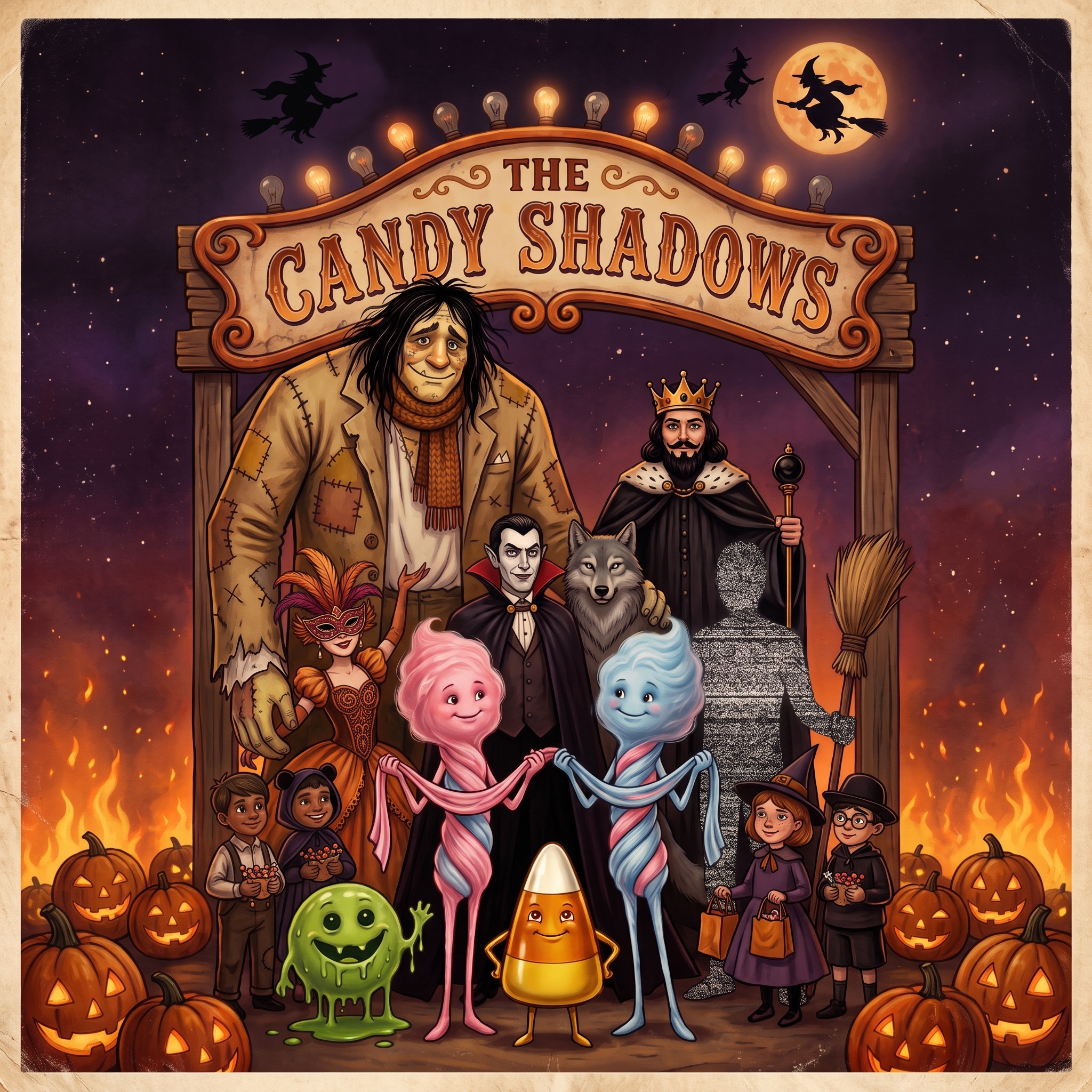
There is a carnival arch at the end of an ordinary street. It has thirteen bulbs along the top, and not all of them burn.
One third of October, the sweet candies caught the Black Licorice King and shut him away for eternity. Then they put up the lights and opened a carnival.
The taffy twins, Poppy and Pippy, greet you at the gate. Everything they say is true, they say. Every song here is somebody you will meet inside.
On the third of October, the sweet candies caught the Black Licorice King and locked him away for eternity. Then they hung up the lights and opened a carnival. The Candy Shadows is a Halloween album about everybody you meet under the arch: the taffy twins Poppy and Pippy, a golden candy corn, a cheerful green blob called Icky Ooie, thirteen witches, a stitched giant who dances as gently as he…
An introduction from Denny
Denny Marlowe, the overnight man on Savrok Radio, on the record and how the coloring book came to be.
Evening. Denny Marlowe, Savrok Radio. I do the overnight, and I have been asked to say a few words about the record you are looking at, which I am glad to do, because for once I know how it came to be.
The Candy Shadows is Savrok's Halloween album. A carnival at the end of an ordinary street, the sweet candies who run it, and the one bitter king they put away for good. He wrote the songs one at a time, the way he writes everything, mostly at night.
Somewhere in the middle of writing them he noticed something. The songs had started answering each other. The twins at the gate turned up in a second song, and then a third. The king had a history. It was not a batch of songs any more. It was becoming a story, and a story that could turn into something more than songs.
So he made a coloring book. His words, not mine. The whole cast is in it, the arch with its thirteen bulbs, the king behind his bars, and every page is one you color yourself, which is a thing a record cannot be.
Could this lead to more Candy Shadows stories? I asked him that. He said perhaps, and he let it sit there, and I know better than to push. Thank you, all of you, for coming to the carnival. The songs are just below. You're tuned to the Vale.
Denny's voice is not here yet, so here are the words.
The songs
Press any song to play it. 12 songs.
-
2:39Candy Shadows
Words
Verse Shadows crawl beneath the door Echoes creak across the floor Monsters scratching at the night Candies scream in moonlit fright Verse 2 Pumpkins glow with haunting smiles Cobwebs stretch for miles and miles Ghostly whispers in the trees Drifting with the autumn breeze Chorus Black cats purr and witches cackle Skeletons begin to rattle Candy treats and spooky beats Dance with fear on ghostly streets Verse 3 Owls hoot from hidden nests Zombies dressed in tattered vests Eyes of jack-o-lanterns gleam Haunting every candy dream Bridge Creepy laughter fills the air Costumed creatures everywhere Haunted whispers linger long Welcome to our eerie song Verse 4 Cloaked in shadows footsteps fall Nighttime comes with eerie call Vampires lurking out of sight Mischief rules this eerie night -
3:02Poppy and Pippy
Words
Hello hello we're— —glad you came Poppy here and— —Pippy's my name Cotton candy colors bright We've been watching— —day and night Do you wonder how— —things began? Meet the shadows— —understand the plan? Long ago before— —the games were made That's when we first— —learned to stay Come and play with Poppy Pippy Skip along the carnival so zippy Riddles hiding answers deep Secrets that we— —always keep Pink and blue we'll— —guide you through Everything we say— —is true Every single day— —we mark them all Spring through summer— —winter into fall Third of October— —changed it all forever We remember— —what they can't remember If you want to— —learn our tale Follow clues along— —the candy trail Solve the puzzle— —win the prize We've got ancient— —memories inside Bridge (Poppy) Listen close we'll tell you why (Pippy echo) tell you why (Poppy) Some questions don't get answered by and by (Pippy echo) by and by (Both) Taffy stretches, never breaks (Both) Pulling fast is all it takes Chorus Come and play with Poppy Pippy Skip along the carnival so zippy Riddles hiding answers deep Secrets that we— —always keep Pink and blue we'll— —guide you through Everything we say— —is true When you leave you'll— —take us with you We're the friends who— —always stick to you Year by year we'll— —meet again Poppy Pippy— —your forever friends -
2:46The Golden Candy Corn Quest
Words
Verse In the forest where shadows play Golden candy corn hides away Through the trees we slyly creep Hoping secrets it will keep Verse 2 Across the rivers mountain high Underneath a pumpkin sky Stepping softly in the night Guided by the moonlight bright Chorus The golden candy corn shines like a star We'll find it no matter how far Its treasure calls us on this quest The sweetest prize the very best Bridge Climbing ladders of licorice vines Candy apples hanging from signs Whispers of sugary delight We'll find it with all our might Verse 3 In the castle of caramel cold Guarded by statues sweet and bold We'll unlock the mystic door For the corn we so adore Chorus The golden candy corn shines like a star We'll find it no matter how far Its treasure calls us on this quest The sweetest prize the very best -
2:22Icky Ooie
Words
Verse In the night so dark and chilly There's a splotch that's kinda silly Dripping down from skies so high Icky ooie mounds nearby Verse 2 From a world we can't explain Creeping weirdness in our lane Slithers through the barren ground Icky ooie makes no sound Chorus Icky ooie in the night Glowing green giving fright From the void it takes a spin Halloween oozes begin Verse 3 No one knows where it will go Spreading slow with eerie glow Kids all scream and run away Icky ooie here to stay Bridge Oh the mysteries unfold Ancient stories left untold Through the mist it now appears Icky ooie fuels our fears Chorus Icky ooie in the night Glowing green giving fright From the void it takes a spin Halloween oozes begin -
2:46The Witches Broom
Words
Verse 1 The broom knocks twice at the door Bows low across the porch floor Pats its straw like a saddle seat Lifts off over the street We glide Verse 2 Hold the handle, lean the bends Rooftops, weathervanes, and friends But when the east goes thin and gray The witches broom Poof!! Goes away (ahhhhhh haaaaaa) Chorus Through the midnight sky we fly Witch-hats snagging clouds up high Children grip the straw tight-white Then it's poof - into the night (ahhhhhh haaaaaa) Hook The Witches Broom (ahhhhhh haaaaaa) Verse 3 Cackles bounce off chimney stacks The wind ties knots no comb takes back The witch grins wide, tips her hat Then drops you off where your porch light's at (ahhhhhh haaaaaa) Verse 4 Cobwebs catch the moon like lace Roof to roof the bristles race One last loop around the steeple Gone before it wakes the people (ahhhhhh haaaaaa) Bridge Back it sweeps to who-knows-where Kids wake up with wind-tossed hair Straw stuck to a pajama sleeve The only proof - and they believe Till next October's eve (ahhhhhh haaaaaa) The Witches Broom -
3:08The Patchwork Giants Dance
Words
Intro In the tailor's workshop late at night Stitched together by lantern light With a stretch he came alive~ Heard a tune and felt the vibe Verse Boots so big they shake the floor Head too tall to fit the door Patches on his elbows, patches on his coat Six little flowers and a scarf round his throat Chorus The Patchwork Giant's on the floor Moves like you've never seen before With a flower in his great big hand He asks the little girl to dance (to dance, to dance) Verse One two three, he counts out loud One two three, he's getting proud Steps on his toe and then on hers She laughs so hard the whole room stirs Verse He lifts her up onto his boots Spins her round the room in loops Puts a flower behind her ear Says "I only dance one night a year" Chorus The Patchwork Giant's on the floor Moves like you've never seen before With a flower in his great big hand He asks the little girl to dance (to dance, to dance) Bridge One on the table (one!) Two by the door (two!) Three in his pocket (three!) That's only four Two more are hiding somewhere in the room Find them before the end of the tune Outro The music stops He takes a bow Walks her home Says "goodnight for now" Six little flowers on her windowsill Next October he'll be dancing still -
4:53The Black Licorice King
Words
I am the bitter on your tongue The taste that most have never sung Ancient root and twisted vine Only certain mouths like mine Verse They dress me up in crown and throne But every king can feel alone The sweet ones dance while I remain Bound to serve their candy reign Chorus Black licorice, bitter king Taste the grumble that I bring Not for everyone, just few October saved a piece for you Crown of shadow, heart of stone Even kings can't rule alone Verse Watch them celebrate each year With their lollipops and cheer I had seven little crowns Now there's not one to be found I remember different days Before the carnival, before the maze October third, the binding night When sweetness stole my ancient right Verse One on the organ, one on the wall One on the organ, one on the wall One rolled under the banquet hall There's a mouse who grins at me I think he knows where the rest might be Chorus Black licorice, bitter king Taste the grumble that I bring Not for everyone, just few October saved a piece for you Crown of shadow, heart of stone Even kings can't rule alone So when the candy shadows call And sweet ones dance throughout the hall Remember there's a bitter throne Where an old king sits alone Bring me back my crowns, and then I might come out and frown again Ending The crown is heavy The taste is earned Some like it bitter Some never learned -
3:18Vampire and Wolf
Words
(Wolf) Half for me (Vampire) Same time next year? (Wolf) Same gazebo (Both) We'll be late (Vampire) Half for you (Wolf) Half for me (Vampire) Same time next year? (Wolf) Same gazebo (Both) We'll be late (Vampire) Half for you (Wolf) Half for me (Vampire) Same time next year? (Wolf) Same gazebo (Both) We'll be late (Wolf) Half for me (Vampire) Same time next year? (Wolf) Same gazebo (Both) We'll be late (Vampire) Half for you (Wolf) Half for me (Vampire) Same time next year? (Wolf) Same gazebo (Both) We'll be late (Wolf) Half for me (Vampire) Same time next year? (Wolf) Same gazebo (Both) We'll be late (Wolf) Half for me (Vampire) Same time next year? (Wolf) Same gazebo (Both) We'll be late (Vampire) Half for you (Wolf) Half for me (Vampire) Same time next year? (Wolf) Same gazebo (Both) We'll be late -
3:41The Mask Stays On
Words
Tonight I wear a feathered face with pride Picked it from the hook beside the door Golden beak and a ribbon tied Nobody knows who I am anymore (and I like it that way) Pre-Chorus The mirror says I chose the perfect disguise The mirror doesn't know me either, surprise! Chorus The mask stays on Till the clock in the ballroom strikes twelve Spin with the owl and the fox and the cat Nobody's sure who is who after that The mask stays on (stays on, stays on) Till midnight Verse There's a lion by the punch bowl, a swan by the stairs A moon with silver whiskers and a bear with a pair Of spectacles painted right onto his nose And somebody wearing the very same clothes as me~ Pre-Chorus Nine masks waving in the chandelier light Two of them match, and I can't tell which tonight Chorus The mask stays on Till the clock in the ballroom strikes twelve Spin with the owl and the fox and the cat Nobody's sure who is who after that The mask stays on (stays on, stays on) Till midnight Bridge Eleven fifty-nine and the fiddles slow Everybody's reaching for the ribbon bow Ten, nine, eight, the room holds its breath Who's behind the golden beak? Wait and see... Chorus The mask comes off~ When the clock in the ballroom strikes twelve The owl is my teacher, the fox is my dad The cat is the neighbor who said I was bad at the waltz (she was right) The mask comes off (comes off, comes off) At midnight Outro Tomorrow I'll hang it back up on the hook And the mask that was matching mine? I never did look. -
2:53Digital Phantom
Words
Intro (power button... click) (loading... loading...) Somebody's living in the family PC Peeks around the folders where you can't see Pixel eyes and a little pixel grin Press the power button and let me in Verse I make the cursor wiggle when you look away I turn the wallpaper purple just to say hey I hide inside the games where the sound is loud I'm the ghost in the keyboard and I'm pretty proud Chorus I am the glitch in your machine tonight Digital Phantom made of pixel light Your screen will flicker when I pass on through Error message: BOO! Digital Phantom, digital phantom Press any key, I'm waving at you Verse Follow the wire from the power switch Past the mouse and the printer, don't you twitch Through the fan and the chips where it's warm and bright That's where I keep my blanket and my night-light Bridge P-H-A-N-T-O-M dot E-X-E (dot E-X-E!) Not a virus, not a bug, just me (just me!) Pop-up smiley in the corner of your eye Click me and I'll blink, and then I'll fly Chorus I am the glitch in your machine tonight Digital Phantom made of pixel light Your screen will flicker when I pass on through Error message: BOO! Digital Phantom, digital phantom PHANTOM.EXE found: it's you! Outro (shutting down...) Low battery, time for bed Pull the blanket over my pixel head I'll be here when you boot me up (goodnight... goodnight... click) -
3:2613 Witches of Halloween
Words
Intro 13...Witches Verse 1 At noon the church clock coughs thirteen The first one's stirring the fountain green Her laugh rolls down the grocery aisle The kids go quiet, single-file Verse 2 At one o'clock a broom's parked neat Outside the diner on Main Street From two to six they land in rows Cackling over the radios Chorus Thirteen witches rise on Halloween One an hour where the clock hands lean At midnight sharp the circle bends And Mother Witch tells how it ends Verse 3 Seven, eight, and nine touch down The year they waited's over now At ten they ring the hollow oak And every chimney holds its smoke Bridge Eleven - and the wires all hum Dead leaves drill like a marching drum Then midnight: heels on the courthouse dome The thirteenth witch - and she says, "I'm home" Chorus Thirteen witches rise on Halloween One an hour where the clock hands lean At midnight sharp the circle bends And Mother Witch tells how it ends Outro 13 witches seen -
3:39Candy Shadows Return
Words
Intro Beneath the door they're back once more Three-six-five, they kept the score Scratching days on the pantry wall Watching the porch light down the hall The hinges find their voices fast Cobwebs sugar-spun at last They know which children moved away And which ones stayed to see this day Candy shadows dance and spin Come outside and let us in Pumpkin grins remember faces Back in all the same old places Black cats purr by the porch's light We've been waiting for tonight Children brave and children new Some remember what we do The carnival bulbs warm up slow Three-six-five until the show We kept your secrets through the year Every laugh and every fear We heard you practice being brave We know which nightlight that you saved Empty streets won't stay that way The curbs fill up by end of day Caramel voices, soft and late This year we knock instead of wait Candy shadows dance and spin Come outside and let us in Pumpkin grins remember faces Back in all the same old places Black cats purr by the porch's light Welcome back to shadow night Year by year we'll always stay Waiting for this special day Mark the calendar in red We'll be waiting overhead Twelve more months until we're free See you next October...three
The storybook
As the twins told it to Tavrin, the man with the lute.
The Twins at the Gate
And so to the carnival, which stands at the end of an ordinary street, under an arch with thirteen bulbs along the top of it, not all of which burn; and the first thing anybody meets under that arch, before the games and before the music, is two tall thin figures made of pulled taffy, one pink and one blue, who have been standing there since before the games were made.
Poppy is the pink one and Pippy is the blue one, and they are twins, and they are made of the carnival the way a wave is made of the sea; and they finish each other's sentences, so that a thing one of them starts is a thing the other one ends, and after an hour of it a person stops noticing where the join is, which is the point.
I asked them how long they had stood at the gate, and Poppy said longer than, and Pippy said the games, and Poppy said longer than, and Pippy said the lights; and then they both said, at once, since the third of October, and looked at each other as if one of them had said too much, and then laughed, which they do a great deal.
Everything they say is true. They say so themselves, and they are right, and the trick of it is that a true thing said by a twin in a sweet voice sounds like a riddle, and most people hear the riddle and miss the truth. I have learned to write down what they say and read it back later, slowly, and it is always plainer than it sounded.
They have a motto, which they will give to anybody who stands still long enough: taffy never breaks unless you pull too fast. They mean the taffy, which they pull between them under the arch in long pink and blue ribbons that children are allowed to touch; and they mean the carnival, and they mean the story, and they mean, I think, the people who come in, who should take their time.
They keep the calendar. Every day of the year they mark, Poppy says, spring through, and Pippy says, summer, and Poppy says, winter into, and Pippy says, fall; and the one day they mark twice, in red, is the third of October, which was the night, they say, that changed it all forever, and which they remember when the rest of the town cannot.
They have a candy trail. It runs from the arch to somewhere, and it is laid in sweets, and a child who follows it clue by clue arrives at a puzzle, and a child who solves the puzzle wins a prize; and I asked what the prize was, and Poppy said you will know it, and Pippy said when you see it, and that was all I got, and I have come to think it was all there was to get.
They are not frightening. I say that first, before the rest of this book, because the carnival has a king in it who is not pleased, and witches, and a thing that lives in a machine, and a blob; and all of it is cheerful, and all of it was explained to me by two taffy twins who wanted me to understand that the carnival is a kind place that keeps its promises, and keeps them every October.
When a visitor leaves, the twins say that they will go with them. Not follow; go with. You take us with you, Poppy says, and Pippy says, we're the friends who stick to you; and that is a taffy joke, and it is also true, which is how everything under that arch works, and it is the first thing to know about the Candy Shadows, and the last.
The Third of October
And so to the king, who is the only one under the arch who is not smiling, and who has his reasons, and who gave them to me himself, through the bars, at length, in a voice like a church organ with a cold; and the first thing to say about the Black Licorice King is that he is bitter, and that he knows it, and that he is proud of it, because bitter is what he is for.
He is the taste that most people have never liked. Ancient root and twisted vine, he says, only certain mouths like mine; and before the carnival, in the days he calls the different days, he was the king of all the sweets, and the sweets did not care for that, because a king of sweets who is bitter is a king who does not understand his own kingdom.
He had seven little crowns. That is the detail every version of this story keeps, so I keep it. Seven small crowns of black licorice, one for every day of the week, and he wore them in turn, and the sweets say he wore them unkindly; and the king says he wore them correctly, and that correctly is what a king is for, and both of those are true, which is the trouble with a king.
On the third of October, which the twins mark in red, the sweet candies rose up. Not with a war; sweets do not war. The way the twins tell it, the sweets simply went in to see him all at once, the candy corn and the taffy and the caramels and the gumdrops, cheerfully, in a crowd, and asked him to step into a room for a moment, and he did, and the room had no door.
That was the binding night. The king calls it the night sweetness stole his ancient right, and says it from behind the bars with his arms folded; and the twins call it the night that changed it all forever, and say it holding hands. It was the same night. I have stood between the two accounts and I will say that nobody was hurt, and that the room is comfortable, and that he is fed.
The seven crowns went missing in the crowd. The king has counted the places where they are not: one on the organ, he says, one on the wall, one rolled under the banquet hall, and the other four he will not guess at; and there is a mouse who grins at him from a crack in the floor of the cell, and the king is certain that the mouse knows where the rest of them are, and the mouse is not saying.
And then the sweets hung up the lights. Thirteen bulbs along the arch, and the music box, and the games, and the twins at the gate to greet whoever came; and they opened a carnival on the spot where the kingdom had been, and they kept the date, and every third of October since they have put the lights up again and told the story again, within the king's hearing, which he minds.
Here is the part the sweets leave out and the king puts in, and which I believe. He is lonely. A king in a cell with no door, who frowns at a carnival he can hear and cannot join, is a lonely thing; and once a year, on the night the lights go up, the sweets leave him a piece of the carnival on the floor by the bars, and he eats it, and does not say thank you, and the next year they do it again.
He has a request. Bring me back my crowns, he says, and then I might come out and frown again; and I told him I would mention it on the air, and he said that would do no good, and I said that was probably so, and here I am mentioning it. If anybody finds a small black crown under a banquet hall, the king would like it, and would not thank them, and would be glad.
That is the third of October, which is why the carnival exists, and why the bulbs are up, and why the king frowns, and why the twins hold hands when they tell it. Some like it bitter, the king says, and some never learned; and the carnival, which is sweet all the way through, keeps one bitter thing at the back of it on purpose, so that it remembers what it is.
The Patchwork Giant and the Girl
And so to the giant, who was made in a tailor's workshop late one night, out of whatever the tailor had left, patches on his elbows and patches on his coat and an orange scarf round his throat; and the tailor stitched him by lantern light and went to bed, and some time before morning the giant stretched, and heard a tune from somewhere, and stood up.
He is very tall. His head does not fit through a door and his boots shake the floor, and when he first walked out into the carnival the games stopped and the music box wound down and the twins, who are not easily surprised, said oh, together; and the giant stood in the middle of it all with his big grey hands at his sides, not knowing what to do with them.
A little girl in a bear hood walked up to him, because children do. She looked up a long way and asked him whether he could dance, and he said he did not know, and she said that the way to find out was to try, which is the best advice anybody at that carnival has ever given, and he bent down, and she took his hand, which was bigger than she was.
One two three, he counted, out loud, because he had never done it before and did not want to get it wrong; and he stepped on his own toe, and then on hers, and she laughed so hard that the whole carnival stirred and came to look, and he was so ashamed that he nearly sat down, and she would not let him, and they went on.
He had six little flowers in his coat, which the tailor had sewn there for no reason anybody knows, cloth flowers, orange and purple; and when the dance was going well enough that he dared to let go of her hand, he took one out and put it behind her ear, and told her, very seriously, that he only danced one night a year, and that she had better make it count.
He lifted her up onto his boots and spun her round the room, and the twins say it took eleven turns, and the king says, from the back, that it was nine and that he was counting; and when the music stopped the giant took a bow, which bent him nearly in half, and walked her home down the ordinary street with the lights behind them, and said goodnight for now.
The flowers are the game. Every year since, on the one night he dances, the giant hides his six little flowers about the carnival for the children to find, and the children count them out loud: one on the table, two by the door, three in his pocket, which is only four; and the last two are always somewhere nobody has looked yet, and are always found before the end of the tune.
The girl is older now. She comes back every October, in the same bear hood, which fits her less well each year, and the giant does not seem to notice, and bends down just as far, and counts out loud just as carefully; and on her windowsill at home there are six little cloth flowers in a row, one for each year, and room for more.
I asked the giant what he does the rest of the year, and he thought about it for a long time, because he thinks slowly and does not like to be wrong, and then he said that he waits, and that waiting is not hard when you know what you are waiting for; and then he asked me whether I could dance, and I said I did not know, and he said the way to find out was to try.
Vampire and Wolf
And so to the vampire and the wolf, who walk under the arch together every October, side by side, the vampire in his cape with the red lining and the wolf grey and tall at his shoulder; and the thing to know about them is that they were not always friends, and that the way they became friends is a truce, and that the truce is renewed every year in exactly the same words.
The quarrel, in the old days before the carnival, was about the night. The vampire wanted the night and the wolf wanted the night, and there is only one night, and a town is only so big; and the twins say that for years the two of them met on the same ordinary street at the same hour and glared, and nothing came of it, because a vampire and a wolf are both too polite to start anything.
On the third of October, the binding night, while the sweets were busy with the king, the vampire and the wolf found themselves standing next to each other under a gazebo in the rain, with nobody watching; and the vampire said, half for you, and the wolf said, half for me, and that was the whole of the treaty, and they shook on it, which is difficult for a wolf.
Half for you, half for me. The vampire takes the night until the clock strikes twelve and the wolf takes it after, or the other way about, depending on which of them you ask, and they do not agree, and they have never needed to; and every year on the same night they meet at the same gazebo to renew it, and every year they are late.
I have heard the renewal. It goes like this. The vampire says, same time next year, and the wolf says, same gazebo, and they both say, we'll be late; and then the vampire says, half for you, and the wolf says, half for me, and they say it all again, and again, and they do not tire of it, and the whole conversation is four lines long and has lasted longer than the carnival.
They are late because of each other. The vampire waits for the wolf to arrive first so as not to seem eager, and the wolf waits for the vampire for the same reason, and so each of them stands round the corner from the gazebo in the dark for a quarter of an hour, and then they both walk up at once, and both apologise, and both say it does not matter, and it does not.
The children love them. Not because they are frightening, which they are not, but because they are a pair, and a pair that argues gently about who gets which half of a thing is the most comfortable sight in the world to a child who has a brother or a sister; and the children follow them under the arch in a line, saying half for you, half for me, until the twins hand out taffy to stop it.
I asked the vampire, once, whether it would not be simpler to have the whole night, and he looked at me as if I had suggested eating garlic, and said that a whole night is a lonely thing, and that half of one shared with a wolf is a night with somebody in it; and the wolf, who does not say much, said, half for me, and I took that as agreement.
So if a vampire and a wolf are seen walking down an ordinary street in October, side by side, late, it is not a hunt. It is two old friends going to a gazebo to say four lines to each other that they have said a hundred times, and will say a hundred more, and mean every time.
The Mask Stays On
And so to the ballroom, which is at the carnival's far end past the games, with a clock over the door and a chandelier that the twins light one candle at a time; and once a year, on the night the lights go up, there is a masquerade in it, and the rule of the masquerade is the whole of the story, and the rule is that the mask stays on until the clock strikes twelve.
The masks hang on hooks by the door, and anybody may take one. A golden beak with a ribbon, an owl, a fox, a cat, a lion, a swan, a moon with silver whiskers, a bear with a pair of spectacles painted on its nose; and the moment a person puts one on, nobody in the room knows who they are, and that, the dancer who told me this said, is the best feeling there is, and she likes it that way.
She wore the golden beak. She picked it off the hook beside the door and tied the ribbon and looked in the mirror, and the mirror did not know her either, which surprised her, and pleased her; and then she went in and danced with the owl and the fox and the cat, and nobody was sure who was who after that, and nobody minded.
There was a lion by the punch bowl and a swan by the stairs and the moon was dancing badly and apologising for it; and in the middle of the second waltz the dancer in the golden beak noticed, across the room, somebody wearing the very same clothes as her, down to the ribbon, and stopped, and counted the masks in the chandelier light, and there were nine, and two of them matched.
She could not tell which. That is the riddle of the chapter, and she will tell you so herself, and she has never solved it, and she is glad. Two masks in a room of nine that are the same, and one of them is yours, and you do not know which of the other eight is the other one; and all evening she danced wondering, and the wondering was better than the dance.
At eleven fifty-nine the fiddles slowed. Everybody in the ballroom reached for their ribbon at once, which is the custom, and the clock began, ten, nine, eight, and the room held its breath, and at twelve the masks came off, and the owl was her teacher, and the fox was her father, and the cat was the neighbour who had said she was bad at the waltz.
She was right, the dancer says, about the waltz. The neighbour was right. She says it cheerfully, because a thing that is true and said kindly is a thing you can keep, and she keeps it, and dances no better for it, and does not care.
And the matching mask. Here is the part of the chapter that the twins made me promise to tell exactly, because it is the part that is true in the way their things are true. When the clock struck and the masks came off, the dancer in the golden beak did not turn round to see who had been wearing the other one. She hung her mask back on the hook, and went home, and she never did look.
I asked her why not, and she said that some questions do not get answered by and by, and that this was one she had decided to keep; and I said that was the twins' line, and she said that she had got it from them, at the gate, on her way in, and had not understood it until midnight, which is when most of their lines come clear.
The Digital Phantom
And so to the phantom, who is the one character at the carnival I could not sit down with, because he lives inside a machine, in the dark warm places behind the fan, between the folders where nobody looks; and the twins arranged the meeting by borrowing a computer from somebody's family and setting it up on a stall, and pressing the power button, and standing back.
He appeared the way the record says he does: loading, loading, and then a figure made of static, grey and white noise with flecks of blue, a pixel grin and two pixel eyes, peeking round the edge of a folder as if he had been caught at something; and he had, because he had been turning the wallpaper purple, which he does when nobody is watching, to say hello.
He makes the cursor wiggle when you look away. He hides inside the games where the sound is loud, and makes the screen flicker when he passes through, and once in a while an error message comes up that says only boo, with a smiley face in the corner of it; and if you click the smiley face he blinks, and then he flies, and that is as near to a conversation as most people get with him.
He is not a virus. He is firm about that, and he spells it out, letter by letter, so there can be no mistake: P, H, A, N, T, O, M, dot E, X, E; and he says it the way a man gives his name at a door, with the file name after it so you know he is not a bug and not a trick, just himself, and pretty proud of it.
He showed me where he lives. Follow the wire from the power switch, he said, past the mouse and the printer, through the fan and the chips where it is warm and bright; and there, in a corner of the machine where nothing is stored, he keeps a blanket and a night-light, and the night-light is on, because the inside of a computer is dark and he does not care for the dark.
He came to the carnival with a family who brought their computer to the masquerade one year to play the music, and he liked the music, and when they packed up he stayed in the machine and went home with them, and has been there since, peeking round the folders; and the twins say he is the only one of the Candy Shadows who lives in a house all year, and that he is good about it.
He is a child's kind of ghost. He does not want to frighten anybody. He wants you to know he is there, and to press any key, and to wave; and the error message that says boo is his idea of a knock on the door, and the purple wallpaper is his idea of a present, and if a child has ever found the cursor somewhere it was not left, that was him, saying good morning.
When the battery ran low on the borrowed machine he yawned, which is a thing to see in static, and said that it was time for bed, and pulled his blanket over his pixel head; and the last thing on the screen before it went dark was shutting down, and under it, in small letters, goodnight, goodnight, and then a click.
I will add one thing, for anybody who has a machine at home and has wondered. He is not in every machine. He is in one. But he has friends, he says, in a great many, and they are all like him, and none of them are viruses, and all of them would like you to press any key, and wave.
Icky Ooie
And so to Icky Ooie, who is a blob, green, round, cheerful, with two big friendly eyes and a wide smile, who drips; and the first thing to say about him is that he came from the sky, dripping down one dark chilly night from somewhere we cannot explain, and landed in a splotch on the ordinary street, and has been here ever since, and is here to stay.
Everybody screamed. The twins are honest about that. The children ran, and the grown-ups ran after the children, and the king, from his cell, said that he had told them so, which he had not; and Icky Ooie sat in his splotch in the middle of the street and looked at all of them running away with his big friendly eyes and did not understand, and made no sound, because he never does.
He gets about by storm drain. That is the thing people find hardest to forgive him for, because a blob coming up out of a drain in front of the bakery is a surprise however friendly he is; and he has learned to come up slowly, and to wave first, and the bakery has learned to leave a bun on the step, and the two of them have an understanding.
He glows. Green, at night, softly, like something under the sea; and the children who screamed the first time are the children who, the second year, followed the glow down the street to see where it went, and found him sitting on the kerb at the end of it, dripping, and sat down with him, carefully, because he is sticky, and found that he was good company.
I sat with him myself, on the kerb, and he is sticky, and I had straw from a broom on my coat for a week afterwards that would not come off; and he said nothing, because he never does, and I played him a slow one, because he looked like a blob who would prefer a slow one, and he moved a little, side to side, which the twins say is dancing.
Nobody knows where he will go. He spreads slow, the record says, and it is right, and the spreading is him going for a walk; and the only places he has ever gone, in all the years, are the bakery step, the kerb at the end of the street, the drain by the carnival arch, and once, on a cold night, the giant's boot, where he sat until the giant noticed, and did not mind.
The mysteries unfold, the record says, and ancient stories are left untold, and that is true as far as it goes; and what I will say is that a blob who came from the void and found an ordinary street and a bakery and a kerb, and stayed, is not a mystery that needs solving. He liked it here. That is the whole of the story, and the carnival is kinder for it.
He is allowed under the arch. The twins decided that the first year, when he came up out of the drain by the gate and everybody else had an opinion; and they said, together, that everything under the arch was welcome under the arch, and that was that, and he slithered in, slowly, and glowed at the music box, and has had his own corner of the carnival since, with a drip tray.
So if there is a green glow at the end of an ordinary street some chilly night, it is Icky Ooie, going for a walk, slowly, saying nothing. Sit with him if you like. Wear old clothes.
The Witches' Broom
And so to the broom, which belongs to a witch, and which goes out on its own. It knocks twice at a door, on an October night, late, when the house is asleep; and if a child opens the door the broom bows low across the porch floor, the way a horse would if a horse could, and pats its straw like a saddle seat, and waits.
The child gets on. They always do; the twins say there has never once been a child who looked at a bowing broom on the porch and went back to bed, and I believe it, because I was that child once and I did not go back to bed either. You hold the handle. You lean into the bends. And the broom lifts off over the street, and the street falls away, and you are flying.
Rooftops, weathervanes, chimney stacks. The broom goes roof to roof, the bristles racing, and it loops the steeple once for luck and never twice, and the witch-hats of the witches who are also out that night snag on the clouds up high; and the children grip the straw tight-white and do not scream, because there is nothing to scream about, only everything to look at.
The bends are the best part. The broom does not fly straight; it swoops down a street and up over a roof and round a chimney, and a child who leans the wrong way feels the straw tilt under them and leans the right way at once, without being told, the way a child on a bicycle learns the first time; and after three roofs they are steering, and after six the broom lets them think so.
The witch is there, sometimes, on another broom alongside, and she grins wide and tips her hat; and she has a laugh that bounces off the chimneys, and the wind ties knots in the children's hair that no comb will take back in the morning, and that, the twins say, is the point of the hair, which is the proof.
The broom knows where every child lives. When the ride is done it drops each one off where their own porch light is, gently, and bows again, and goes on to the next; and when the east goes thin and grey, and the first of the morning is in the sky, the witches' broom goes poof, just like that, and is gone, and is back the next October, knocking twice.
In the morning the children wake up with wind-tossed hair, and straw stuck to a pajama sleeve, and that is the only proof there is; and they believe it, all of them, and nobody else does, and that is the correct arrangement, and the broom is careful to keep it so.
I asked the twins where the broom sweeps back to, when it goes poof, and Poppy said who, and Pippy said knows, and Poppy said where, and they laughed; and then Pippy, quietly, said that the broom goes back to the witch, and that the witch goes back to the thirteen, and that the thirteen are another chapter, and that I should wait.
One more thing, for the parents. The broom has never dropped anybody. Not once, in all the years, over all the roofs; and the cobwebs it flies through catch the moon like lace and never catch a child, and the one loop round the steeple is slow. It is a good broom. It was made by somebody who liked children, and it shows.
The Golden Candy Corn Quest
And so to the candy corn, which is the treasure of the whole carnival, and small, and gold, and glowing; a candy corn in white and orange and golden yellow, with thin stick arms and legs and a smile on it, pleased with itself, and it has every right to be, because every other thing under the arch is a game and this is the prize.
It hides. That is its nature; a treasure that sat in the middle of the carnival on a cushion would not be a treasure for long, and the candy corn knows it, and so every October it goes away before the lights come up, and the quest begins, and the quest is the game the children like best, and the twins lay the trail for it.
The trail goes into the forest where the shadows play. It crosses the rivers and climbs the mountain high, under a pumpkin sky, with the moon for a lantern; and the children go softly, in a line, stepping over roots, because the candy corn is said to have good ears and to hide deeper if it hears them coming, which is not true, but keeps the line quiet.
The rivers are crossed on stepping stones that are peppermints, round and white, and slippery, and nobody has ever fallen in, because the rivers at the carnival are an inch deep and made for crossing; and the mountain is high only in the way a mountain is high to somebody small, and at the top of it the pumpkin sky is close enough, the children say, to touch, and some of them try.
There are ladders of licorice vine to climb, which are sticky, and candy apples hanging from the signposts, which may be eaten, and are, and whispers of sugary delight from somewhere ahead, which are the twins, hiding, encouraging; and at the top of the mountain there is a castle, and the castle is made of caramel, cold, and the door is shut.
The castle is guarded by statues, sweet and bold, which is to say they are made of sugar and look stern and do nothing at all; and the children stand in front of them and are stern back, which is the custom, and then somebody finds the key, which is always the smallest child, because the key is always hidden low.
And the mystic door opens, and there in the dark of the caramel hall is the golden candy corn, shining like a star, on a plate, with its stick arms up in the air; and it is pleased to be found, every year, as if it had never been found before, and it hops down and comes out into the moonlight with the children in a procession, and the carnival lights come up as they arrive.
That is the quest, and that is what the record means when it says its treasure calls us on this quest, the sweetest prize, the very best; and I asked the twins what the prize is, as I said in the first chapter, and they would not say, and now I will, because I have watched the children come down the mountain. The prize is having gone.
The candy corn goes back up the mountain the next morning, on its own, hopping, pleased, and hides again; and the twins lay a new trail, with new clues, and in a year the whole thing happens again, and the children who went last year go again, and are never bored, because the prize was never the corn.
If anybody follows the candy trail from the arch, which I have told the man in the booth not to do from up there, this is where it goes. Bring a child, if you have one. Let them find the key.
The Thirteen Witches
And so to the witches, who are thirteen, and who come one an hour on the one day of the year, which is how the town keeps count of them and how the witches keep count of the town; and the first thing to know is that they are not frightening either, however many there are, and that the children of the ordinary street wait for them the way children wait for snow.
At noon the church clock coughs thirteen. It strikes twelve every other day, and on the one day it coughs once more, as if it had something in its throat, and that is the sign; and the first witch is already stirring the fountain green with the end of her broom by the time the last cough has gone, and her laugh rolls down the grocery aisle, and the children go quiet, single file.
At one o'clock a broom is parked neat outside the diner on Main Street, the way a horse would be tied, and the second witch is inside having pie, and tips well; and from two to six they land in rows, four of them, in the square, cackling over the radios that every shop has on, because the radios play the carnival's music on that day, and the witches like it.
The diner keeps a pie for the second witch. It has done for as long as the diner has stood, and the pie is always the same pie, which is pumpkin, and the witch always says it is the best she has had, which the cook has stopped believing and has not stopped liking; and the children who come in at one o'clock to watch her eat it are given a slice each, and told to sit still, and do.
Seven, eight and nine touch down in the dusk, and the year they waited is over, which is what they say to each other, every year, as if the waiting had been long; and at ten the tenth rings the hollow oak at the edge of the town with the handle of her broom, three times, and every chimney in the town holds its smoke for a moment, and lets it go.
Eleven, and the wires all hum. That is the eleventh, who is fond of the wires and walks along them; and the dead leaves in the gutters drill like a marching drum, and the whole town is awake now, and at the windows, and counting, because everybody knows what comes at midnight and nobody wants to miss it.
Then midnight. Heels on the courthouse dome, the record says, and that is exactly it: the thirteenth witch comes down out of the dark and lands on the dome of the courthouse with both heels, neatly, and stands up straight, and looks round at the town with its lights on and its windows full, and says, I'm home.
She is the Mother Witch. The other twelve are hers, in the way that the twins are the carnival's, and once a year at midnight on the dome the circle bends, which is to say the twelve brooms rise up off their parking places and make a ring round the courthouse with her at the top of it; and then she tells how it ends.
I have asked what she tells, and I have been told by the twins, by the king, by the giant, who was there once, and by a child who had been allowed to stay up; and all of them say it differently, and all of them say it the same, which is that she tells the story of the carnival from the third of October to tonight, and ends it with the words see you next October, and then the brooms go poof.
The thirteenth is the one on the clock tower in the picture, if anybody has the record and has counted twelve. She is small in the picture because she is far away. She is not small.
The Shadow Children Return
And so, at the last, to the shadows themselves, the candy shadows, who are two small children in dark coats with their faces hidden except for a glint of eyes, one with a candy bag and one with a handful of wrapped sweets that catch the light; and they are the first thing on the record and the last thing in the book, because they are the ones who wait.
They wait under the door. Not a particular door; the door of whatever house has a child in it who remembers them, which is most houses on the ordinary street; and they wait the whole year, three hundred and sixty-five days, scratching the days off on the pantry wall in a row, and watching the porch light down the hall, and keeping score.
They know which children moved away. They know which ones stayed to see this day. They know which nightlight you saved when the others were thrown out, and they heard you practise being brave in the mirror, and they kept every laugh and every fear through the year the way the twins keep the calendar; and none of that is meant to frighten, the twins say, and I agree. It is meant to show that somebody noticed.
On the night the lights go up, they come out. The hinges find their voices, the cobwebs are sugar-spun at last, and the pumpkins on the steps grin with faces they remember from last year; and the shadow children walk down the ordinary street toward the arch with the bag swinging, one of them looking back, which is the one who always looks back, to see who is following.
Everybody is following. That is the chapter. The giant with the girl on his boots, the vampire and the wolf side by side and late, the dancer in the golden beak, Icky Ooie slowly behind, the candy corn hopping, the broom overhead with nobody on it, the thirteen witches in a ring across the moon, and at the back, carried in his cell on a cart by the sweets, because they would not leave him, the king, frowning.
And under the arch the twins, pulling taffy, pink and blue, finishing each other's sentences, saying welcome back to shadow night; and the bulbs along the top of the arch come on one at a time as the procession passes under them, thirteen, and not all of them burn, and nobody has ever said why, and I have decided not to ask.
This year, the shadow children say, we knock instead of wait. That is the only new thing in the song, and the twins made sure I had it right, because it matters: for all the years before, the shadows waited under the door to be let in, and this year, for the first time, they will knock, like the broom does, twice; and a child who opens the door will find the whole carnival on the step.
They are not coming to take anybody. I say that plainly, because the record sings it in a voice that could be taken two ways, and the twins were very clear, and the king, who would tell me if it were otherwise, was clear too. They are coming to be let in. They have waited a year. They would like a sweet, and to say hello, and to be remembered, and then to go back under the door and start counting again.
Mark the calendar in red, the twins say. Year by year they will always stay, waiting for this special day; and when the last bulb on the arch goes out at the end of the night and the carnival packs up and says it will see you next October, the shadow children go back under the door, and scratch the first day on the pantry wall, and the whole thing begins again.
Twelve more months, the song says, until we're free. See you next October, three. That is the end of the storybook, and the beginning of the year, and the twins at the gate, who told me all of it, say that everything they said was true, and that I may keep it, and that I will take them with me, which I have.
Who you will meet
- Poppy and Pippy The taffy twins. They finish each other's sentences and they have been watching.
- The Black Licorice King Bitter, crowned, and not for everyone. The one face under the arch that is not smiling.
- The Golden Candy Corn The treasure. Follow the candy trail.
- Icky Ooie A cheerful green blob who gets about by storm drain.
- The stitched giant He dances with a little girl, as gently as he can.
- The vampire and the wolf They have called a truce and walk in together.
- The masked dancer, the phantom made of static, and a broom with nobody on it All three are at the party.
- Thirteen witches Overhead. The thirteenth is on the clock tower.
The coloring book
Every character has a page to color, and most pages hide a puzzle: mazes, hidden candy to find, witches to count. For ages four to eight, and for anybody older with a box of pencils.
Open the book for the contents, and a page you can color right here.
